

News & Events
 Find the latest news below, and our event calendar on the right.
Would you like to stay updated on our latest research news, publications and events? Please subscribe to our monthly newsletter!
Posted on 9 November 2011, last modified on 9 October 2023
10 February 2020
In preparation for the 'Africa 2020' workshop about The Nile on 20-21 February, Germa Seuren of the ASCL Library and PhD candidate Abeer Abazeed (co-organiser of the workshop) have compiled a web dossier about The Nile's governance and the distribution of its waters. It includes titles from the ASCL Library collection, the broader Leiden University Library collection, and the library of IHE Delft Institute for Water Education. Read the web dossier!
06 February 2020
31 January 2020
Sixty years ago seventien African countries became independent. Despite economic growth, unemployment is still high, and many of these countries are faced with poverty, terrorism and war. Neo-colonialism is not the heart of the problem, ASCL researchers Chibuike Uche and Akinyinka Akinyoade say in an interview in Trouw; 'the failure of Africa is an African problem'.
31 January 2020
In the 19th century Abirè Goro, singer-prophet in Central Mali, gained a huge reputation that still reverberates among the Dogon. His main legacy, a cycle of songs called the baja ni, is still sung as part of the funeral rituals, a performance during the night lasting seven hours. Wouter van Beek and colleagues have for the first time transcribed, translated and put into print these songs. The book is in French and contains a CD.
31 January 2020
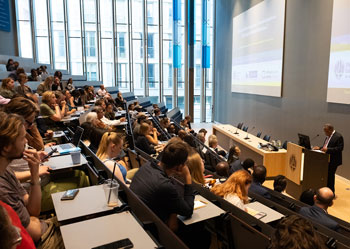
On 30 January 2020, LeidenASA and the ASCL organised the conference 'Africa: 60 Years of Independence' in Leiden. It was the kick-off for 'Africa 2020', the year in which 17 countries on the African continent celebrate 60 years of independence. Keynotes were given by Lungisile Ntsebeza (University of Cape Town), Birgit Meyer (Utrecht University), Carolyn Hamilton (UCT) and Jan Abbink (ASCL/Leiden University), who gave their views on decolonising the academy, religion, the use of oral archives, and changes of leadership in Ethiopia and Sudan.
27 January 2020
The print culture of 1920s Lagos, Nigeria, was innovative and effervescent. Numerous new weekly and daily newspapers were started in this decade. Five of these papers were in Yoruba and sought to convene a wider audience than before. During the online ASCL Seminar on 7 October Karin Barber (University of Birmingham) will suggest that this resulted in the establishment of several new genres, the most influential of which was the famous confessions of a fictional Lagos 'harlot', Sẹgilọla.
23 January 2020
On the occasion of the special 'Africa 2020' year, the ASCL and its Library have made several knowledge products relating to 60 years of independence: a thematic map 'Africa at 60'; a web dossier on African Leaders of Independence; an overview of the 17 countries that gained independence in 1960, offering web resources and selected open access publications; and infosheets about the countries that became independent in 1960. The infosheets kick off with Cameroon.
21 January 2020
Klaas van Walraven learnt of the existence of a burial ground for Dutchmen in Brazzaville, dating from the late 1880s. Congo-Brazzaville was never a Dutch possession. So why does it boast a Dutch cemetery? And who are the young men lying there? Read his latest contribution to the ASCL Africanist Blog!