

CRG Seminar: Dealing with Anthrax at the Cattle Frontier: Local Understandings, Colonial Technopolitics and Transimperial Vaccines in French Madagascar, 1895-1960
Primary tabs
In the nineteenth century, Madagascar became an important exporter of cattle commodities, most notably hides, meat and live cattle, to both global and regional markets. French colonisation from 1895 fuelled and reshaped this cattle frontier, with French administrators, entrepreneurs and veterinary scientists, along or against local actors, trying to further adapt Malagasy cattle bodies, socio-economic practices and ecological conditions to a colonial-capitalist model of commodity production. Drawing on extensive archival research in France and Madagascar, this presentation analyses how anthrax – a widespread and very deadly zoonotic disease caused by the bacterium Bacillus anthracis – threatened the profitability of this cattle frontier; and how colonial actors responded to this challenge that was co-produced by the specific properties of the bacterium, cattle mobility and varying disease susceptibility, Malagasy pastoralists’ Eigensinn and colonial-capitalist extractivism. It argues that mass vaccination of cattle, rather than sanitary measures, became the preferred approach in colonial Madagascar, as it was a cheap technological fix to a complex medical, environmental and social problem and much in line with French-Pastorian approaches to disease. While vaccination numbers gradually rose to several million yearly, only equalled in Africa in Southern Africa, the campaigns depended much on newly trained cheap, yet vulnerable Malagasy veterinary assistants, as well as potent vaccines. Vaccines were produced locally but their development and use were caught between French-Pastorian vaccine nationalism and Madagascar’s transimperial exchanges with South Africa.
This seminar is given by Samuël Coghe and organised by the Collaborative Research Group Trans-species perspectives on African Studies. This event will take place in person in Leiden.
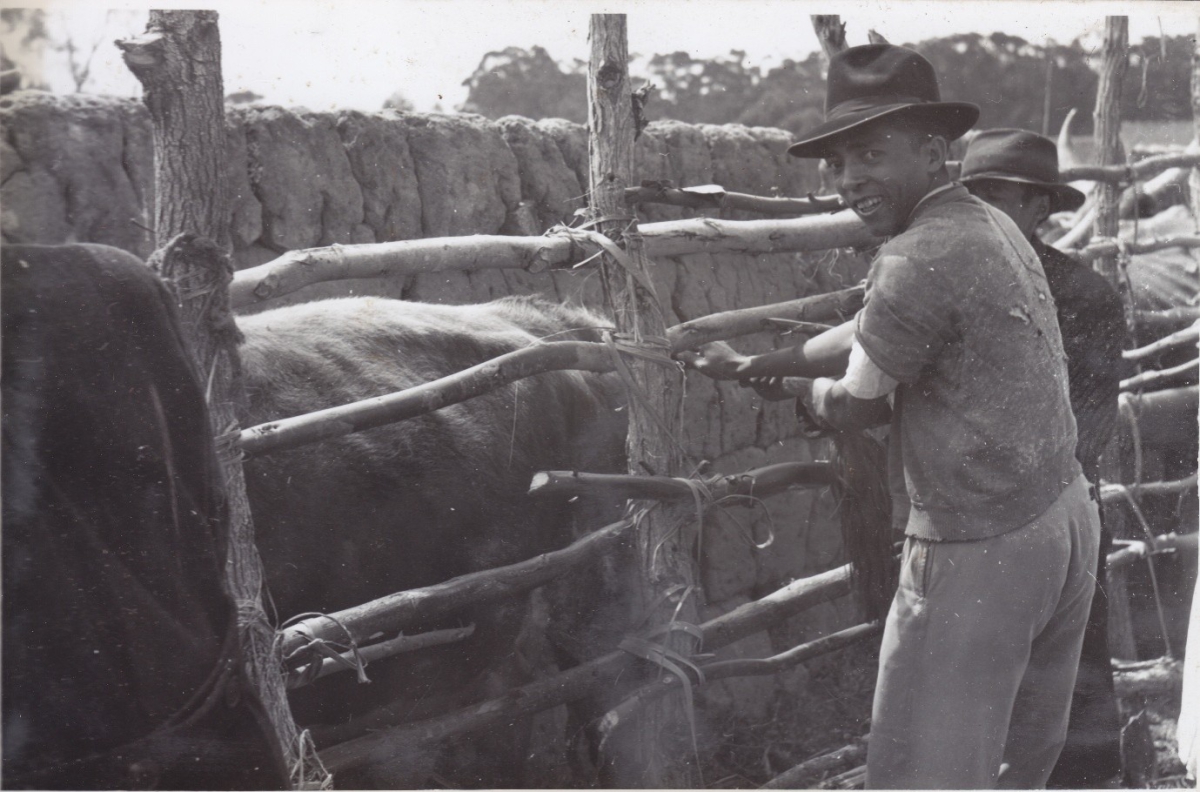
Image credit: Vaccination against anthrax in Ambohitrolomahitsy, 26 August 1954. Corridor with unknown Malagasy veterinary assistants or doctors, holding the tail of a zebu to vaccinate. Source: Bibliothèque Nationale de Madagascar (Antananarivo), FO2, N° 219.
Speaker

Samuël Coghe is Associate Professor of African and Global History at Ghent University. He studied history in Berlin and Lisbon, obtained his PhD at the European University Institute in Florence and held various positions at universities and research institutes in Berlin and Gießen. His research focuses on the history of European colonialism in Africa, with particular attention for the history of science, environment and capitalism, and for transimperial and global perspectives. He is the author of Population Politics in the Tropics. Demography, Health and Transimperialism in Colonial Angola (CUP, 2022) and currently leads the ERC project (Post)Colonial Cattle Frontiers. Capitalism, Science and Empire in Southern and Central Africa, 1890s-1970s (2023-2028). His work on cattle frontiers has thus far been published in journals such as Environmental History, Geschichte und Gesellschaft and The American Historical Review, and the Routledge Handbook of Pastoralism. He is also a core member of the Commodities of Empire research group and the Commodity Frontiers Initiative.
Date, time and location
12 November 2026
15:30 - 17:15
Herta Mohr Building / Faculty of Humanities, Witte Singel 27a, 2311 BG Leiden
Room 0.31
Registration
Posted on 19 October 2026, last modified on 19 October 2026