
CRG seminar: The (counter-)politics of green hydrogen in the Global South: Insights from Africa and Latin America
Primary tabs
This seminar brings together two fresh perspectives on the emerging geographies, politics, and lived experiences of green hydrogen across the Global South. Through grounded empirical research from Chile and insights from a grassroots encounter between African and Latin American civil societies in Namibia, the session interrogates how green hydrogen futures are imagined, enacted, and contested, and how these dynamics shape broader debates on energy transitions, extractivism, and decarbonized development.
The politics of green hydrogen futures in Southern Patagonia, Chile
Tomás Ariztía, School of Sociology, Universidad Diego Portales, Chile
Drawing on three years of ethnographic research in Magallanes (southern Chile), this presentation examines the normative and political frictions that underpin the anticipation of green hydrogen (GH2). We first describe how GH2 futures in Magallanes are enacted through different modalities of anticipation. Three key modalities of anticipation are described: the first involves performances that stage the value and desirability of GH2. We describe how technology fairs, pilot projects, and demonstrations are central to highlight the imminence of GH2. The second concerns the creation of anticipatory narratives around the viability and value of GH2. We explore how these narratives are constructed and used in public documents and discourses to justify GH2imminence. The third modality involves the spatialisation of the potential economic value of GH2 using maps and representations. We show how these modalities of anticipation reveal a particular politics of GH2 futures, marked by the dominance of planetary-scale technoeconomic interventions and the entanglement of mitigation and economic profit. In doing so, we argue that this type of ecomodernist energy future marginalises alternative pathways for the energy transition and makes it challenging to problematise the various normative and political frictions at play in the deployment of GH2.
Fostering South-South ties ‘from below’ in green hydrogen: Insights from a grassroots encounter between Africa and Latin America
Eric Cezne, African Studies Centre, Leiden University
Touted as a key pillar of industrial decarbonization, green hydrogen has spurred a growing body of social science research that continues to expand across new disciplinary, empirical, and conceptual terrains. Much of this work has examined the transnational dimensions of green hydrogen – ranging from diplomacy and trade to emerging global production networks – while also engaging critically with questions of green extractivism and coloniality, particularly in North South relations. Yet little is known about how distinct lived experiences with green hydrogen landscapes across the Global South relate to, diverge from, or illuminate one another. This presentation offers a fresh perspective by drawing on insights from a South–South grassroots encounter held in March 2026 in Namibia, which brought together hydrogen-affected community representatives, indigenous leaders, and civil society organizations from Namibia, South Africa, Brazil, Chile, and Colombia – countries central to Global North hydrogen import strategies. It explores the prospects, possibilities, and challenges for rethinking ‘energy transitions’ through bottom-up South–South interactions, contestations, and solidarities around green hydrogen. It contributes to scholarship on the political geographies of green extractivism by advancing a transnational perspective ‘from below’ on hydrogen, and to South–South cooperation studies by showing how such ties are mobilized and made meaningful within a nascent, uncertain, and speculative industry in decarbonized development.
This event will take place in person in Leiden. For registrants who cannot travel to Leiden, a link to an online platform will be sent before the start of the event.
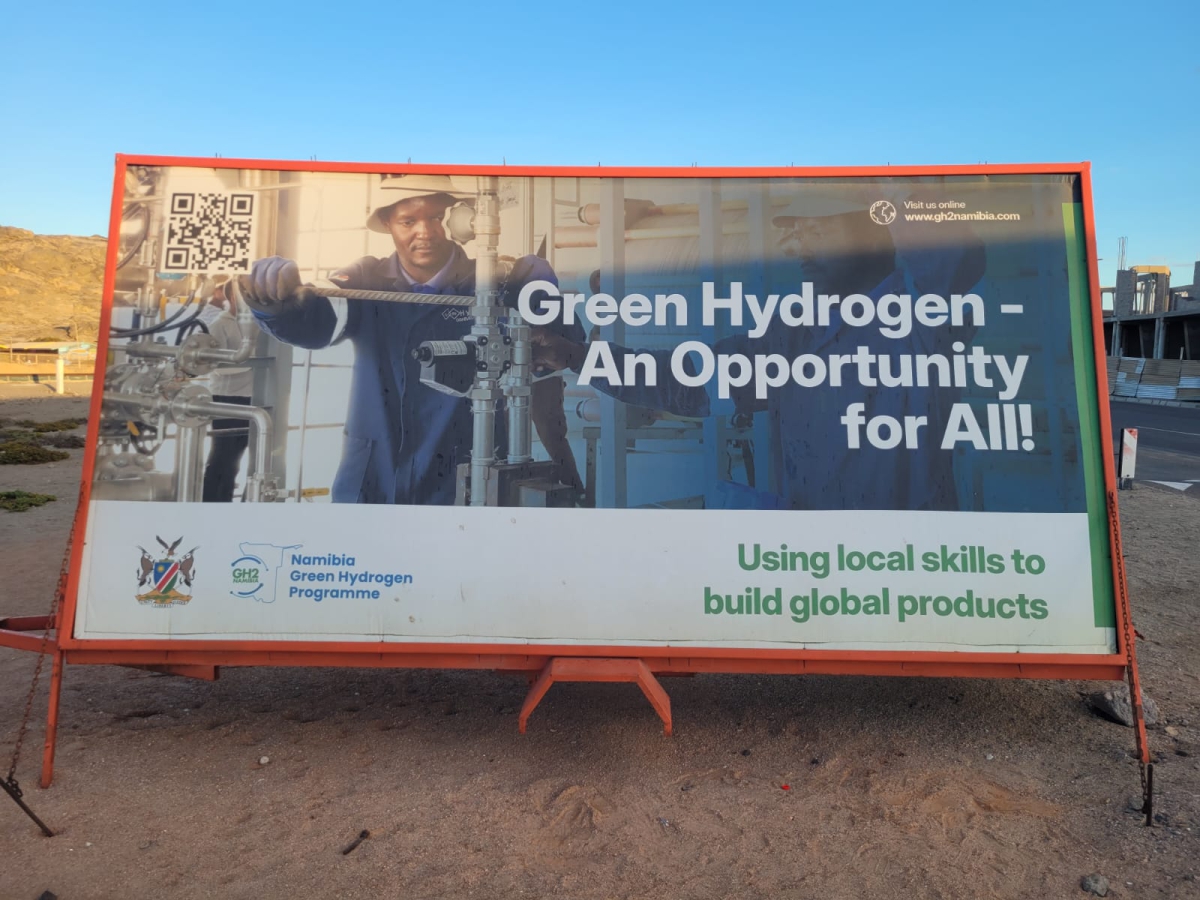
Image credit: Roadside promotion billboard for green hydrogen in Lüderitz, Namibia. Picture: Eric Cezne, March 2026
Speaker
 Prof. Dr. Tomás Ariztía is Professor of Sociology at Universidad Diego Portales in Santiago, Chile.
His work lies at the intersection of science and technology studies (STS), economic sociology, and environmental sociology, with a focus on the cultural, social, and political dimensions of sustainable energy transitions in Chile and Latin America. He is currently the Principal Investigator of The Millennium Nucleus on Citizen Technoscience for Socio-Environmental Transformation (CITEC) research project.

Eric Cezne is a Postdoctoral Researcher at the ASCL, working on the political geographies of energy transitions and decarbonisation in Africa (especially in the realm of green hydrogen). More broadly, his research interests include Africa’s South–South relations, infrastructure politics, the extractive industries, Lusophone Africa, and the BRICS group.
Eric has completed a PhD in International Relations (cum laude, 2021) at the University of Groningen, approaching the making of Africa’s South–South relations in expanding mining frontiers.
He has taught at the Free University of Amsterdam (Dep. of Political Science and Public Administration) and held research positions at Utrecht University, the Centre for Global Cooperation Research (University of Duisburg-Essen, Germany), and the Peace Research Institute Oslo (PRIO).
He has taught at the Free University of Amsterdam (Dep. of Political Science and Public Administration) and held research positions at Utrecht University, the Centre for Global Cooperation Research (University of Duisburg-Essen, Germany), and the Peace Research Institute Oslo (PRIO).
Date, time and location
14 April 2026
15:00-17:00
Herta Mohr Building / Faculty of Humanities, Witte Singel 27a, 2311 BG Leiden
Room 0.31
Registration
Posted on 24 March 2026, last modified on 2 April 2026