

CRG Seminar: “The China Girls”: Development Dreams, Labor Struggle and Global Entanglements in Ethiopia’s Special Economic Zones
Primary tabs
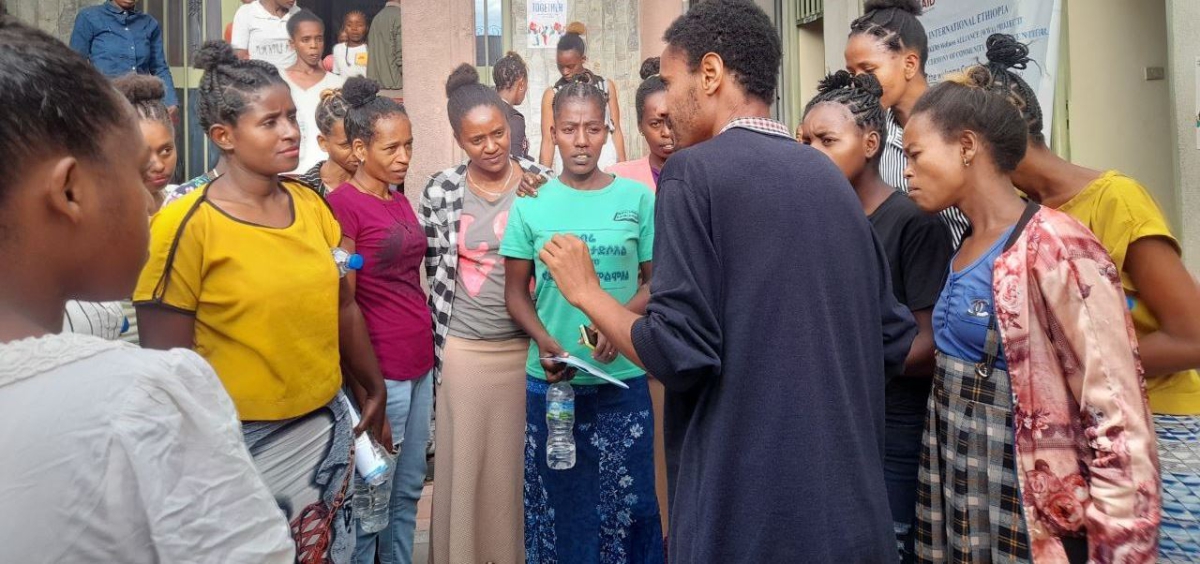 A central claim in debates on Africa’s shifting global relations is that South–South cooperation, particularly through large-scale infrastructural projects can drive technology and skills transfer. Visiting fellow Robel Mulat Asmammaw revisits this assumption in the context of recent global and local shocks and their uneven consequences on the ground. Drawing on ethnographic research in Ethiopia’s Hawassa Special Economic Zone (HSEZ), the study analyzes how multipolar power dynamics, particularly among China, the United States, and Ethiopian state actors are experienced and reinterpreted by local industrial workers. Moving beyond macro-level analyses, it examines how shifting trade regimes have reshaped working and living conditions of workers. It argues that the material and symbolic dimensions of development interventions, shaped by global capital, elite-driven imaginaries, and geopolitical shifts, intersect in the everyday lives of workers in ways that both reproduce and reconfigure inequality. As a result, HSEZ emerges not merely as a production site connecting Africa to the global economy, but also shapes how global power is perceived, interpreted, and contested in everyday life.
This seminar is given by Robel Mulat Asmammaw and organised by the Collaborative Research Group Africa in the world.
This event will take place in person in Leiden. For registrants who cannot travel to Leiden, a link to an online platform will be sent before the start of the event.
Photo taken by Ermias Abebe
Speaker
Robel Mulat Asmammaw is an Assistant Professor at Dilla University, Ethiopia and holds a PhD from the University of Gondar. As an urban anthropologist, his research examines on the intersection of urbanisation, industrialisation, and migration. His recent work focuses on the Hawassa Special Economic Zone (HSEZ) in Ethiopia, the largest in Africa, critically analysing how infrastructural development shapes urban ecology through the experiences of migrant workers. His scholarship has been published in journals including Eastern African Studies, Work in the Global Economy, Social Sciences & Humanities Open, and London School of Economics blog. He regularly writes his academic work into public dialogue through blogs and opinion pieces in both Amharic and English.
During his fellowship at ASCL, Robel will work with the CRG Africa in the World. He will develop and complete a research project that interrogates Africa’s evolving global connections through the lens of infrastructure and labor. Using HSEZ as a case study, it explores how multipolar power dynamics, particularly between China, the US, and local actors are experienced and negotiated in the everyday lives of migrant workers.
Date, time and location
10 June 2026
13.30 - 15.00
Herta Mohr Building / Faculty of Humanities, Witte Singel 27a, 2311 BG Leiden
Room 0.31
Registration
Posted on 18 May 2026, last modified on 8 June 2026