

Onitsha market literature and the Nigerian response to Lumumba’s death
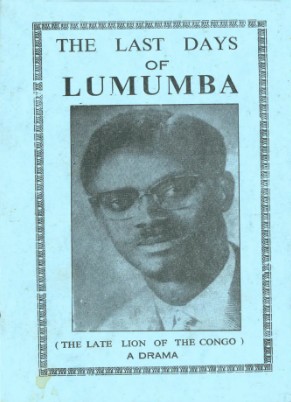 The news of Patrice Lumumba’s murder in the Congo in February 1961 sparked unexpected anti-white riots in Nigeria, a country where race relations had not been a prominent issue for over a decade. Public interest in the former Belgian Congo was stirred not only by Lumumba’s death, but also by the continuing involvement of Nigerian officials, troops and police in United Nations operations in the Congo.
Among educated Nigerians, attention to pan-African issues was clearly growing, and events in the Congo played a significant role in awakening this awareness. Pamphlets recounting Lumumba’s life and mourning his death circulated widely, while local newspapers carried discussions of various aspects of the Congo crisis. In his article on Nigerian pamphleteers and the Congo, published in 1964, Ken Post examines the popular attitudes expressed in these publications - both towards Lumumba’s death and towards broader political themes - and relates them to contemporary developments in Nigerian domestic politics.
Ken Post (1935–2017) was a British political scientist who served as Professor of Political Science at the Institute of Social Studies (ISS) from 1969 until his early retirement in 1990. His archive, now housed at the African Studies Centre Leiden, includes a collection of these pamphlets, which formed the basis of his analysis.
Most pamphlets were published in Onitsha, a bustling commercial town in south-eastern Nigeria that became the centre of a remarkable grassroots publishing phenomenon in the 1950s and 1960s, now known as the Onitsha Market Literature movement. During this period, the city’s vibrant Onitsha Main Market was home to dozens of small-scale printers and booksellers who produced inexpensive pamphlets and booklets, often sold directly on the streets.
Onitsha market literature remains fascinating today because it offers a rare, ground-level perspective on how ordinary Nigerians experienced the rapid social and political changes of the mid-twentieth century. It captures everyday concerns, emerging political awareness, and the voices of new readers and writers outside formal institutions. The African Studies Centre Leiden is therefore pleased to make these materials available to its users:
- Okenwa Olisah. [1962]. Mr. Lumumba and president Kasavubu in Congo politics : power versus power. Aba : G.C. Moneme.
- Felix N. Stephen.[after 1961]. The trials of Lumumba, Jomo Kenyatta and St. Paul. Onitsha : Njoku & Sons.
- Thomas Iguh. [196x]. The last days of Lumumba (The late lion of the Congo) : a drama. Onitsha : A. Onwudiwe & Sons.
- See also: Ogali, Ogali A. [1961]. The Ghost of Patrice Lumumba. Enugu : Zik Enterprises. Published in Ogali, Ogali A. and others [1980]. Veronica my daughter and other Onitsha market plays and stories. Washington, D.C : Three Continents Press
Other Onitsha pamphlets in the Ken Post Collection:
- Chinaka, B. A. et al. (1964) The life story of Dr. Nkrumah, Dr. Chike Obi and other leaders in Nigeria. Onitsha: Njoku & Sons.
- R.I.M. Obioha. (1964). Sylvanus Olympio : the assassinated president of Togo Republic, a dramatic story of the man who laughed at death. Onitsha : R.I.M. Obioha, Atlantic Printers.
- Uwanaka, C. U. (1960) Zik and Awolowo in political storm. Independence ed. Onitsha [Nigeria]: Ezeagwu Bookshop.
See also: Digital collections of Onitsha market literature
For Onitsha market literature in general, check what the library has on this subject.
Ursula Oberst
Posted on 24 March 2026, last modified on 12 May 2026