
The debate on cultural heritage restitution in writing and art
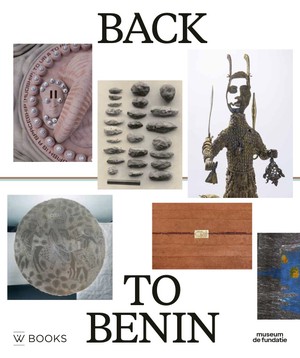 Museum de Fundatie in Zwolle recently announced the restitution of one of the Benin Bronzes, which has been part of their collection since the 1930s. Marking the restitution, the museum has organised the exhibition Back to Benin in which ten contemporary Nigerian artists reflect on the historical, social and cultural meaning of the bronze sculptures. The African Library recently acquired the exhibition catalogue. This catalogue is one of the items highlighted in this month’s Library Highlight, on writings and art related to the ongoing debate on African cultural heritage restitution.
From Dan Hicks’s more militant work, The Brutish Museums, to the more diplomatic yet still uncompromising Sarr-Savoy report, the debate over the restitution of African cultural heritage continues to unfold. However, with the publication of mentioned landmark report, officially titled The Restitution of African Cultural Heritage: Toward a New Relational Ethics (in French Rapport sur la restitution du patrimoine culturel africain: vers une nouvelle éthique relationnelle), the restitution of African heritage appears to have gained momentum after years of frustrated attempts.
Indeed, the debate over the restitution of African cultural heritage is anything but new. In Africa’s struggle for its art: history of a postcolonial defeat, Bénédicte Savoy, one of the world’s foremost experts on restitution and cultural heritage, traces the history of these discussions back to the early years of independence in the 1960s, highlighting numerous African voices that have long advocated for the return of African cultural heritage. One of the leading voices was Amadou-Mahtar M'bow, then Director-General of UNESCO, who brought the debate on restitution back into the public eye in the 1970s. A carefully planned campaign culminated in his famous speech A plea for the return of an irreplaceable cultural heritage to those who created it.
Throughout the 1980s and 1990s, the call for restitution persisted. Various initiatives, such as the report on restitution of African art1, by then inspector general of the Direction of French Museums Pierre Quoniam, or the Abuja Proclamation, attest to this. Yet it was not until 2017, following a speech in support of restitution by French President Emmanuel Macron, that serious efforts were undertaken. After the speech, the landmark Sarr-Savoy report was commissioned and new legislation was passed in Parliament on 7 May that made it possible to repatriate cultural heritage.
Since the report was published, various Western museums and governments have decided to take a critical look at their own collections, conducted provenance research, entered into new partnerships and proceeded to return African cultural heritage. A noteworthy example is the repatriation of a historic sabre, which is said to have belonged to El-Hadj Oumar Tall. After Senegal had been claiming the sabre for years, it was finally handed over to the Musée des civilisations noires in Dakar in 2019. The hidden yet violent colonial history of the sabre is explored by Taina Tervonen in the book Les otages.
In the Netherlands, too, several museums have proceeded with restitution. Following extensive provenance research, Wereldmuseum Leiden decided to repatriate a total of 119 items that are part of the famous Benin Bronzes, looted during the British punitive expedition in 1897. To provide transparency and context, a small booklet with the results of the provenance research was published and it is expected that more such studies will appear in the coming years.
Similarly, Museum de Fundatie in Zwolle has returned one of the Benin Bronzes which had been part of their collection since the 1930s. To commemorate the restitution, the museum organised an exhibition named Back to Benin (running until 7 June 2026), in which ten contemporary Nigerian artists reflect on the historical, social and cultural meaning of the bronze sculptures. The catalogue of the exhibition has recently been added to our collection.
Cultural expressions of the debate
 The debate is not confined to academic circles, artists and writers have also called for the restitution of African cultural heritage in their works ranging from video games to novels, some of which can be found in our collection. One such example is the film Fang: an epic journey (2001), in which an attempt is made to summarise a century of Western thinking on African art on the basis of the history of a single African art object’s journey. Its history is traced back to Cameroon in 1904, with detours to major Western capitals such as Berlin, Paris and New York, only to end up in a museum in the 1970s.
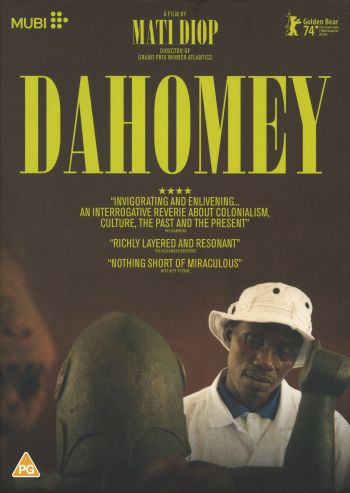
A more recent example is Invasion 1897 (2014) by the Nigerian filmmaker Lancelot Oduwa Imasuen. In the film, a Nigerian student decides to take matters into his own hands and steal a work of art, once belonging to his ancestors, from the British Museum. Another interesting example is the 2024 film Dahomey, a so-called ‘documentary-fantasy’ by Mati Diop. In her work the French-Senegalese filmmaker focuses on the restitution of artefacts from France to Benin, blending in fact and fiction.
Similar themes are also explored in the African-futurist game Relooted, created by the South African game studio Nyamakop. In the video game, African cultural heritage is stolen back from various Western museums. The game’s explicit aim is to spread knowledge about African culture and history. Examples can also be found in more conventional art forms such as literature. Fatoumata Sissi Ngom’s novel, Le silence du totem, is set in a Parisian museum where a curator of African descent discovers a mask that turns her life upside down. Similarly, in The creation of half-broken people, a novel by Siphiwe Gloria Ndlovu, the protagonist, who works for a British museum filled with African artifacts, is happy with her job, until she starts having visions inhabited by “half-broken” women, confronting her with her own heritage and past.
Although more and more cultural heritage is being returned in recent years, there is no doubt that there is still a long way to go. If you want learn more about the restitution debate, browse the list below of selected publications for further reading on the subject.
Joris Martens
Further reading
Back to Benin: nieuwe kunst, eeuwenoud erfgoed = Back to Benin: new art, ancient legacy/ auteurs Minne Atairu, Kokunre Agbontaen-Eghafona, Beatrice von Bormann, Victor Ehikhamenor, Oisasonor Godfrey Ekhator-Obogie, Kristian Garssen, Johan Koers, Aude Christel Mgba ; redactie Beatrice von Bormann, Siji Jabbar, Sanne van de Kraats, Aude Christel Mgba ; vertaling Eveline Deul (ENG-NL), Sue McDonnell (NL-ENG) ; fotografie Elevine Berge, Usiosefe Maty Izegbuwa, Daniel Lawani, Maruani Mercier, ODH Studio, Charles Ofikhenual, Martijn Schmidt.
Zwolle : WBOOKS ; Zwolle : Museum de Fundatie, [2026].
Dahomey/ Mati Diop (dir.)
[London, England] : MUBI [2025].
The creation of half-broken people : a novel/ Siphiwe Gloria Ndlovu, author.
[Toronto] : Anansi International, 2025.
National museums in Africa : identity, history and politics/ Raymond Aaron Silverman, George Abungu and Peter Probst (eds.).
Abingdon, Oxon ; New York, NY : Routledge, Taylor & Francis Group, [2022].
Invisible inventories : questioning Kenyan collections in Western museums/ Marian Nur Goni and Sam Hopkins (eds.).
Bayreuth // Johannesburg : Iwalewabooks // Nairobi : Kwani Trust, [2021].
Un nouvel or noir : Le pillage des objets d art en Afrique/ Philippe Baquér.
Marseille : Agone, [2021].
Provenance #2 : the Benin collections at the National Museum of World Cultures/ Fanny Wonu Veys (ed.)
Netherlands : Nationaal Museum van Wereldculturen, 2021.
The vanishing paths of African artefacts: Mapping the Parisian auction market for primitive objects in the interwar period/ Léa Saint-Raymond and Elodie Vaudry.
In: Journal for Art Market Studies, 2020.
Le silence du totem : roman/ Fatoumata Ngom.
Paris : L'Harmattan, [2018].
Art and museum in Africa : a decolonial perspective/ Emery Patrick Effiboley.
Mankon : Langaa Research & Publishing CIG, 2024.
A programme of absolute disorder : decolonizing the museum/ Françoise Vergès, Paul Gilroy (foreword) and Melissa Thackway (transl.).
London, England : Pluto Press, 2024.
Atlas der Abwesenheit : Kameruns Kulturerbe in Deutschland/ Andrea Meyer and Bénédicte Savoy.
Heidelberg : arthistoricum.net, 2023.
Africa's struggle for its art : history of a postcolonial defeat/ Bénédicte Savoy and Susanne Meyer-Abich (transl.).
Princeton University Press, 2022. French version. German version.
The brutish museums : the Benin Bronzes, colonial violence and cultural restitution/ Dan Hicks.
London: Pluto Press, 2020.
Notes for a long-term approach to the price history of brass and ivory objects taken from the Kingdom of Benin in 1897/ Felicity Bodenstein, Christine Howald, Charlotte Guichard and Bénédicte Savoy.
In: Acquiring Cultures, 2018, p.267-288
Rapport sur la restitution du patrimoine culturel africain : vers une nouvelle éthique relationnelle/ Felwine Sarr and Bénédicte Savoy.
[S.l.] : [S.n.], 2018.
Invasion 1897 : the deposition of the last king of Africa/ Anika Álofti, actor., Rudolph actor. Walker, Mike Omoregbee, actor., Charles Chucky Venn, actor., Lancelot Oduwa film director Imasuen, screenwriter., production company. Wells Entertainment, film distributor. Gabosky Films and production company. Iceslide Films.
Lagos : Wells Entertainment, 2014.
Benin1897.com : art and the restitution question // an art exhibition of installations and sculptures/ Peju Layiwola and Sola Olorunyomi.
Ibadan : Wy Art Editions, 2010.
Fang : an epic journey/ Susan Mullin. Vogel.
Brooklyn, NY : First Run Icarus, 2001.
1 The report mentioned in Sarr and Savoy (2018) and Savoy (2022), entitled Restitution des biens culturels à leur pays d’origine : « Groupe de réflexion pour l’Afrique » can be found here https://archives.quaibranly.fr/ark:/69769/615154.692728 and here https://www.parismuseescollections.paris.fr/fr/musee-d-art-moderne/archi...
Posted on 11 May 2026, last modified on 17 May 2026