
Off to Nairobi: LDE Thesis Lab on Just and Sustainable Urban Transitions
 Early February, a new cohort of master’s students will travel to Nairobi for an LDE Thesis Lab on Just and Sustainable Urban and Energy Transitions in Kenya. The lab brings together students, researchers and practitioners to explore how cities can move towards more sustainable and inclusive forms of development.
The Nairobi Thesis Lab is a collaboration between the African Studies Centre Leiden and Nuvoni Centre for Innovation Research in Kenya, with LDE Global and the International Centre for Frugal Innovation (ICFI) as LDE (Leiden-Delft-Erasmus) partners. It combines academic research with real-world engagement and offers students the opportunity to work directly on urban sustainability challenges in Kenya.
What is an LDE Thesis Lab?
LDE Thesis Labs are designed for students who want to go beyond the boundaries of a traditional master’s thesis. Instead of working in isolation, students join an interdisciplinary learning and research community focused on a shared real-world challenge. Through workshops, methods labs, field visits and collaboration with local partners, they develop their individual theses while contributing to a broader body of knowledge with practical relevance.
In Nairobi, this means working in and with the city itself, engaging communities, policymakers, entrepreneurs and researchers to better understand how waste, energy and climate solutions take shape in everyday urban life.
Nairobi: waste, energy, and climate
Nairobi faces major challenges around waste, energy, and climate. These form the focus of this Thesis Lab, which brings together three connected themes: waste management in cities, carbon dioxide removal technologies, and clean energy transitions. Together, these themes guide students in exploring how urban sustainability can be combined with social inclusion and local needs.
The lab will begin with a one-week intensive workshop in Nairobi from 4 to 11 February 2026, with mini-lectures, field visits and research design sessions. Students who require longer fieldwork for their thesis will stay for two to three months, supported by Nairobi-based and Netherlands-based supervisors and by regular peer exchange within the cohort.
 Meet Fiona and Eduardo
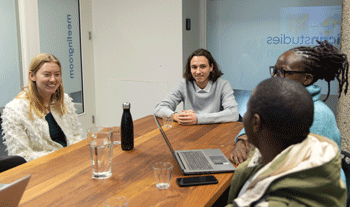
Two of the students who will be joining the Nairobi lab are Fiona (Leiden University) and Eduardo (TU Delft). They recently visited the African Studies Centre Leiden to meet their hosts from Nuvoni, who were in the Netherlands for a visit focused on research, education and engagement collaborations, as part of the preparation phase.
Fiona will work with Nuvoni on waste management and local initiatives.
“I’m especially interested in how local initiatives are involved,” she explains. “Where things already work well, where the gaps are, and how collaboration between communities, NGOs and institutions can be strengthened.”
For her, the lab is about learning through engagement.
“I expect it to be a very fruitful experience, not just academically, but also in terms of working together across different contexts.”
Eduardo will focus on energy access and voltage stability in informal settlements, particularly through battery energy storage systems.
“What I want to understand is how electricity actually reaches people,” he says. “And what alternatives exist if that is not the case.”
He will also speak with businesses to explore whether these technologies are feasible in practice.
“Right now, I am not entirely sure where this will lead, and that is part of the process.”
Beyond the technical aspects, he is looking forward to being in Nairobi.
“Being in a different social and cultural environment will change how I see these questions. I am really looking forward to that.”
We wish Fiona and Eduardo the best of luck with their research and their upcoming stay in Nairobi!
Read more about the Thesis Labs. Application for this semester is closed.
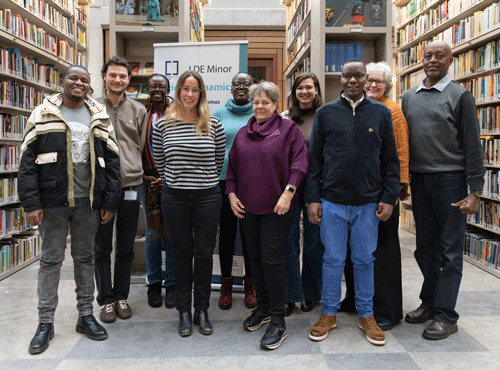
Group photo: Mourice Kausya (Nuvoni), Joris Martens (African Library), Elsie Onsongo (Nuvoni), Caroline Archambault (Leiden University College The Hague), Stella Khaoya (Nuvoni), Madi Ditmars (education development, African Studies Centre Leiden), Jasmin Hofman (coordinator LDE Global/ICFI), Stephen Nyagaya (Nuvoni), Marleen Dekker (director, African Studies Centre Leiden), Musyimi Mbhati (Nuvoni).
Lower photo: Fiona and Eduardo meeting two staff members of Nuvoni: Stella Khaoya and Mourice Kausya.
Posted on 26 January 2026, last modified on 17 February 2026